
 Thailand

Dilute Phase Pressure and Vacuum Conveying: A Comprehensive Guide
In modern industrial processing, transporting bulk materials efficiently, safely, and with minimal product degradation is critical. Dilute phase conveying is one of the most widely used methods for moving powders, granules, and light bulk materials through pipelines. At AMH Technologies, we design and supply custom dilute phase systems tailored to a wide range of industries, ensuring optimal performance, minimal maintenance, and high product quality. This article explores everything you need to know about dilute phase pressure and vacuum conveying, including design considerations, advantages, limitations, and applications.

What is Dilute Phase Conveying?
Dilute phase conveying is a pneumatic system where bulk material is transported through a pipeline suspended in a high-velocity air stream. Unlike dense phase conveying, where materials move in plugs or slugs at low velocities, dilute phase keeps particles fully suspended in the airflow.
There are two main types:
- Pressure (Positive) Conveying – Air is pushed from a blower or compressor at the start of the pipeline to move the material toward the destination.
- Vacuum (Negative) Conveying – Air is pulled by a vacuum pump or exhauster at the endpoint, drawing materials from multiple pickup points.
Both systems are versatile and widely used, but the choice depends on your material properties, plant layout, and operational requirements.
Advantages of Dilute Phase Conveying
Dilute phase systems offer several benefits:
- Flexibility in routing – Can transport materials through complex pipework, including vertical and horizontal bends.
- Reduced contamination – Enclosed systems minimise dust exposure and product loss.
- Scalability – Easy to extend or modify pipelines for future plant expansions.
- Multiple pickup/delivery points – Vacuum systems allow materials from multiple sources to feed a single receiver; pressure systems can feed multiple destinations.
- Ease of automation – Integration with PLC and SCADA systems is straightforward.
Pressure vs. Vacuum Conveying: How They Work
1. Pressure Conveying
Operation:
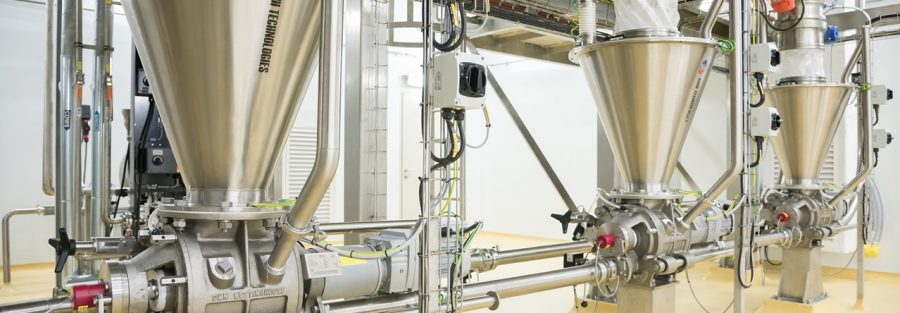
- Material is fed into the pipeline via a rotary valve, screw feeder, or venturi feeder.
- A positive displacement blower or compressed air system pushes the material at high velocity (15–35 m/s) through the pipeline.
- The air-material mixture is separated in a cyclone, filter, or baghouse at the receiving end.
Applications:
- Continuous feeding from one source to multiple destinations.
- Long-distance conveying (up to 500 m).
- Transport of free-flowing powders, pellets, and granules.
Advantages:
- High conveying speed and capacity.
- Reliable over long distances.
Limitations:
- High velocity may damage fragile materials.
- Requires robust pipelines and wear-resistant materials for abrasive products.
2. Vacuum Conveying
Operation:
- Material is drawn into the pipeline from bins, silos, or hoppers.
- A vacuum pump at the receiving end creates negative pressure, pulling the material along.
- The material is separated from air using a filter receiver or cyclone before entering storage or processing equipment.
Applications:
- Feeding multiple pickup points into a single destination.
- Situations requiring gentle handling of materials.
- Dust-sensitive environments.
Advantages:
- Lower velocity reduces product degradation.
- Minimises dust leakage due to negative pressure operation.
- Flexible for multiple pickup points.
Limitations:
- Limited conveying distance compared to pressure systems.
- Typically lower conveying capacity.
Key Design Considerations
Designing an efficient dilute phase system requires careful evaluation of several factors:
1. Material Characteristics
- Particle size & shape – Irregular particles may settle faster.
- Bulk density – Determines the air volume and velocity required.
- Moisture content & stickiness – Sticky or hygroscopic powders may cause blockages.
- Abrasiveness – Highly abrasive materials require wear-resistant pipelines and elbows.
- Fragility – Sensitive powders or granules may require lower velocity or cushioning techniques.
2. Pipeline Layout & Conveying Distance
- Longer pipelines increase pressure drop; pipe bends and vertical lifts require additional blower or vacuum capacity.
- Smooth bends reduce wear and maintain consistent velocity.
3. Air Volume, Velocity, and Pressure
- Air velocity must be high enough to keep particles suspended but not so high that material degradation or excessive wear occurs.
- Pressure drop calculations ensure proper blower or vacuum pump sizing.
4. Feed & Discharge Equipment
- Rotary airlocks, screw feeders, and venturi feeders for pressure systems.
- Pick-up hoppers, vacuum receivers, and filter systems for vacuum applications.
- Properly designed feeding systems ensure consistent flow without surges.
5. Filtration & Dust Control
- Cyclones, bag filters, and HEPA filters prevent dust escape and maintain air quality.
- For food or pharmaceutical applications, filters are designed for hygiene compliance.
6. Automation & Monitoring
- Level sensors, pressure sensors, and flow meters help monitor material movement.
- PLC or SCADA integration allows automated start/stop, alarms, and remote monitoring.